
Should I Stay or Should I Go? Evergreen Funds, GP-Led Secondaries and Where the Real Alpha Lies.
Updated: May 8
Insights from Alpha Edge Europe — Private Markets, London
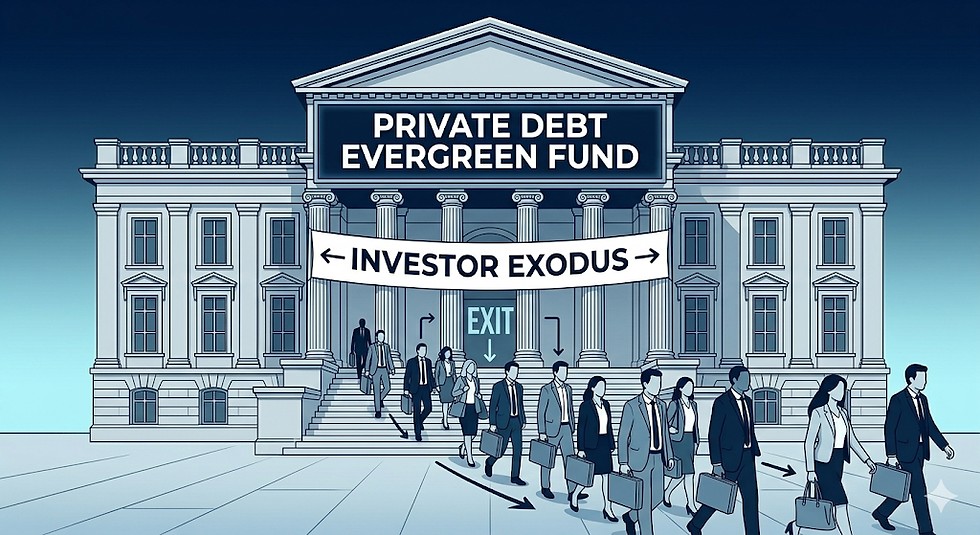
The debate around Evergreen funds and GP-led secondaries is reaching a critical inflection point. As gates activate, valuations come under scrutiny, and Moody's downgrades an entire sector, the structural questions can no longer be deferred.

Recently, Marie-Laure Mikkelsen, Founding Partner of Alfinas Alternative Investment Advisers, joined the panel "Should I Stay or Should I Go?" at Institutional Investor's Alpha Edge Europe — Private Markets in London, April 15-17, 2026,. Moderated by Thanos Papasavvas (ABP Invest), alongside Agnès Lossi (INDEFI, France) and Pascal de Kruijff (APG, Netherlands), our discussion covered three central questions: whether semi-liquid really means illiquid, the composition of GP-led continuation vehicles, and the differences between private equity and private credit in Evergreen structures.
This article presents the full analysis of Alfinas' positions, defended on stage by our Founding Partner Marie-Laure Mikkelsen, the framework she proposed, and the data that supports it.Two weeks later, the Grizzly Research report on Partners Group validated the structural questions raised in London.
The panel debate centred on three fundamental questions that every institutional investor in private markets must confront today.
On the first question — whether semi-liquid really means illiquid — Marie-Laure Mikkelsen argued that the industry has built Evergreen funds inside-out. A genuine semi-liquid vehicle starts with a liquid core and adds illiquidity for return enhancement. Private credit Evergreen funds did the exact opposite — starting with a fully illiquid portfolio and adding a quarterly redemption window for marketing purposes. The wrapper is where the risk lives. And most investors never look there.
On GP-led secondaries — the question is not whether they are legitimate in principle, but whether they are being used to crystallise value or to defer losses. The structural conflict is clear: in both Evergreen funds and continuation vehicles, the GP is simultaneously the seller, the buyer's advisor and the valuation agent. Until independent third-party valuation becomes standard, LPs are making decisions based on marks that serve the GP's interests — not theirs.
On where the real alpha lies in 2026, the Alfinas position was unambiguous: not in structures, but in discipline. European senior secured private credit. Secondaries at a discount. Asset-based finance. Vintage diversification as a tool for strategic liquidity steering. The toolkit exists — without the alchemy.
Two weeks after the panel, Grizzly Research accused Partners Group — Switzerland's largest private markets manager with $185bn AUM — of overvaluing positions in its Evergreen funds by up to 40%. Partners Group strongly denies the allegations and points to PwC and independent external valuers. But the structural questions raised in London are now front page news.
NAV marks are narratives. The question is always whose narrative they serve — and in whose interest they are written.
📄 Download the full panel briefing note and analysis below.
👉 Read our Private Debt Insight Series — March 2026: www.alfinas.com/insights
👉 Read our Macro Confluence Insight Series — April 2026: www.alfinas.com/insights
This article is published by Alfinas Alternative Investment Advisers for informational and educational purposes only. It represents the analytical views and opinions of the author and does not constitute investment advice, a solicitation, an offer, or a recommendation to buy, sell or hold any financial instrument or to adopt any investment strategy. © Alfinas Alternative Investment Advisers, April 2026.


Comments